Concrete Slab & Foundation Work
The foundation of your building deserves expert precision and decades of reliability.
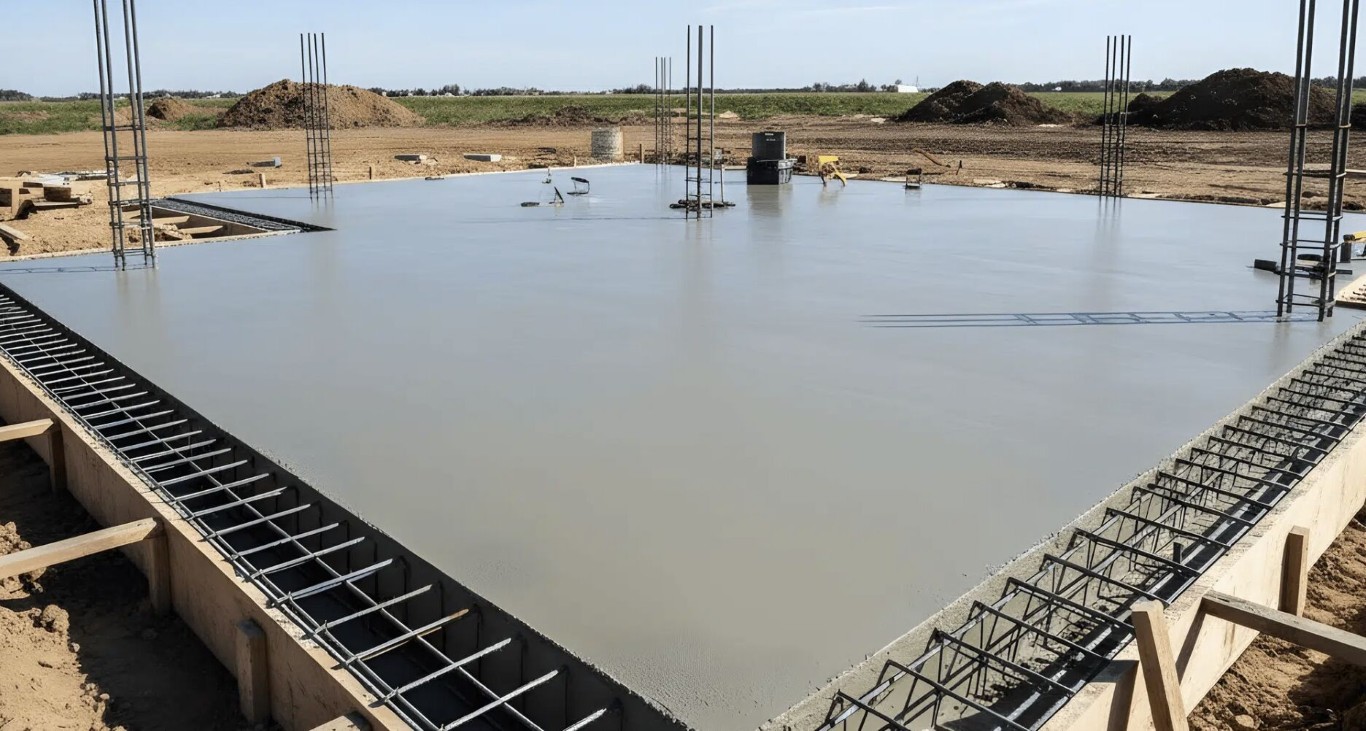
Your foundation is the most important part of any building. Everything else sits on it, so it needs to be done right the first time. Whether you're building a new garage, adding onto your home, or constructing a commercial building, UptownView Chicopee Concrete has the experience and equipment to pour foundations and slabs that last.
We've poured foundations throughout Chicopee and the surrounding areas for residential, commercial, and industrial projects. From simple shed slabs to complex basement foundations with footings, we handle every aspect of the job with the precision it demands.
Foundation and Slab Services We Provide
Different projects need different foundation solutions. Here's what we do and when you'd need each type.
Slab-on-Grade Foundations
This is a single layer of concrete poured directly on prepared ground. It's perfect for garages, sheds, workshops, and some homes. The concrete is typically 4-6 inches thick with a gravel base underneath for drainage and stability. We include wire mesh or rebar for reinforcement and control joints to manage cracking. Slab-on-grade foundations are cost-effective and work well when you don't need a basement or crawl space.
Basement Foundations
Full basement foundations involve footings, walls, and a floor slab. We excavate to the proper depth (typically 8 feet or more), pour footings that spread the building's weight, build or pour concrete walls, and finish with a floor slab. Basement foundations give you extra living or storage space and are common in residential construction throughout Massachusetts.
Footings and Frost Walls
In our climate, foundations need to extend below the frost line (typically 4 feet deep in Massachusetts) to prevent frost heave. We pour footings that go deep enough and wide enough to support your structure. These footings distribute weight and prevent settling. For additions and garages, we often pour frost walls that support the structure without needing a full basement.
Commercial and Industrial Slabs
Commercial projects often need thicker slabs with heavier reinforcement to handle equipment, vehicles, or heavy inventory. We pour slabs up to 8-12 inches thick with proper rebar placement and can include features like trench drains, equipment pads, and anchor bolt placements.
Why Foundation Work Can't Be Done Twice
Here's the thing about foundations: you can't really fix them later without enormous expense. If the foundation settles unevenly, cracks badly, or fails, you're looking at lifting the building or tearing everything down and starting over. That's why we take foundation work so seriously.
- •Proper Excavation: We dig to the right depth, compact the subgrade, and ensure proper drainage away from the foundation.
- •Quality Base Material: We use the right type and amount of gravel, compacted in layers to prevent settling.
- •Proper Reinforcement: We use rebar or wire mesh as required by code and engineering specifications.
- •Correct Concrete Mix: We use the right strength concrete (typically 3000-4000 PSI for foundations) with proper air entrainment for freeze-thaw protection.
- •Precise Leveling: Foundations must be level and at the correct elevation. We use laser levels and proper screeding techniques.
- •Adequate Curing: We protect the concrete during curing to ensure it reaches full strength.
Our Foundation Installation Process
Every foundation job follows a careful sequence. We don't skip steps, and we don't rush. Here's what happens from start to finish.
First, we review your plans and get any required permits. We verify property lines and utility locations. Then we excavate to the proper depth and dimensions. The excavation is carefully graded and compacted. Next comes the gravel base, which we install in layers and compact thoroughly. We set up formwork to hold the concrete to the exact dimensions you need.
Before we pour, we place reinforcement (rebar or wire mesh) according to specifications. We also install any anchor bolts, sleeves for utilities, or other embedded items. Then we pour the concrete, taking care to eliminate air pockets and voids. We screed the surface to the proper elevation and finish it as specified. Finally, we protect the concrete during curing and remove forms at the appropriate time.
The entire process typically takes several days to a few weeks depending on the size and complexity of your project. We coordinate with excavators, inspectors, and other trades as needed to keep your project moving smoothly.